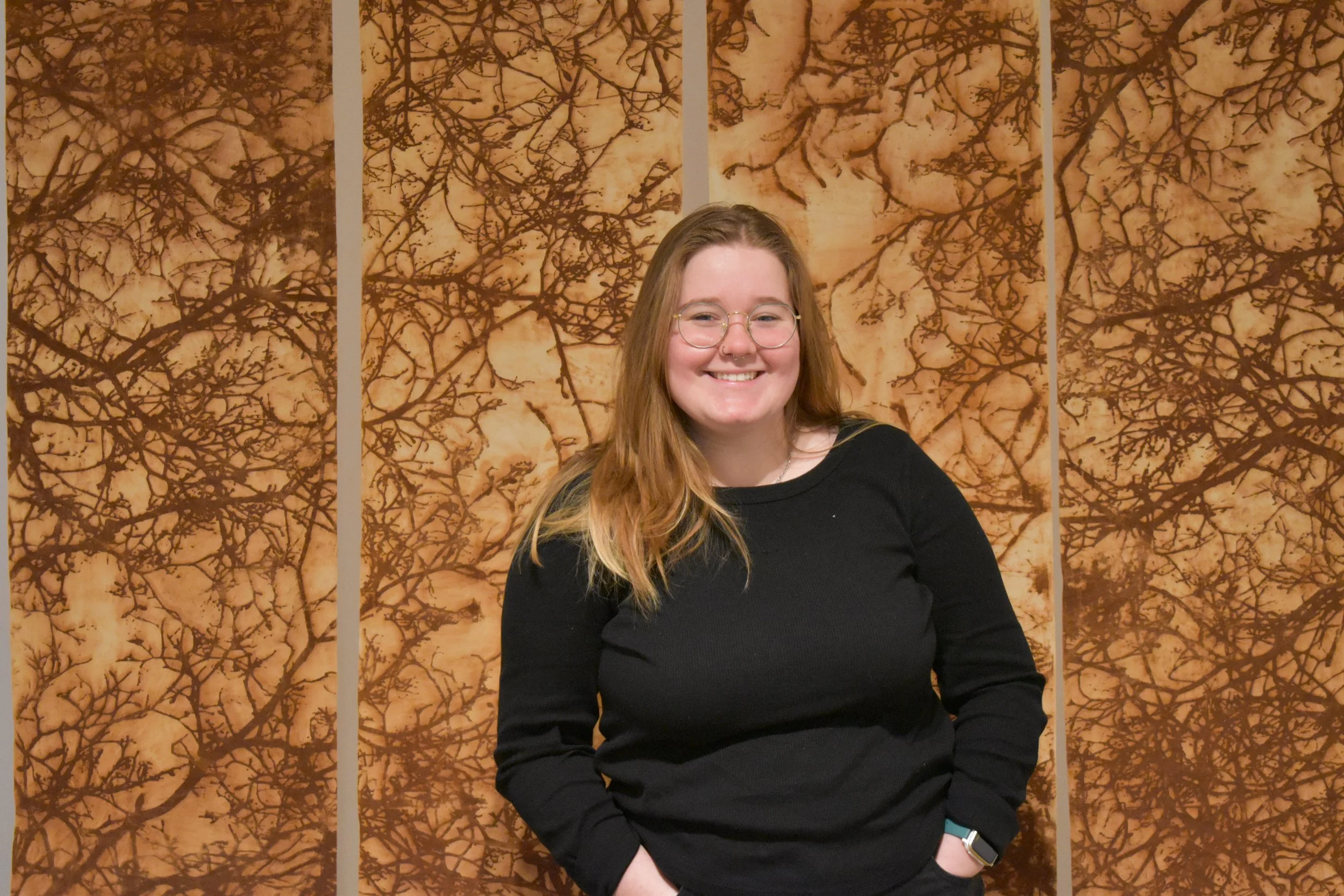
BioCasey Fisher, originally from rural Delaware, is a printmaker whose work considers the intertwined relationships within her local ecology and the evolving iterations of home. Fisher is a current University of Maryland MFA candidate and received her BFA from Lesley University College of Art and Design in 2023. From 2022-2025 she served as the Visual Art Manager at the Boston Center for the Arts where she supported the Boston Art Book Fair, Residency program, and Mills gallery exhibitions. Her work has been exhibited nationally with recent shows included at the Distillery Gallery, Abigail Ogilvy Gallery, (Boston MA), ArtsWorcester, and New Impressions Print Studios. Her work has also been involved in the Boston Printmakers print exchanges and 2023 North American Print Biennial where she received the material award from Zea Mays Print Studio. She was an honorable mention for Stephen D. Paine Scholarship.
StatementThis work explores the intertwined relationships within my local ecology and aims to understand my evolving iterations of “home.” I create large scale, installation based, hybrid prints with a focus on the pace of time, manufactured impermanence and the setting of home in both my domestic and public environment. Dominant influences are the industry around me, and their use of naturally sourced materials: metal, concrete, brick, vines, weeds, and native foliage. I use elements of decay, represented by rusted and patinated structures, to demonstrate the power of nature and its cyclic properties returning these man-made structures to their original roots. Textile structures, highlighting a sense of home, add fluidity and comfort to the work.
I reflect heavily on the print process and allow print to serve as a collaboration between myself and nature. The surface of each plate creates a new landscape and each print holds onto the memories of the landscape, serving as an iteration of the memories our ecology holds from our footprint. This work is speaking to how we create habitable spaces and what those spaces turn into after we are gone. The subjects of this work pull from my personal ecology struggles, managing a world that is no longer natural and exploring the fluidity of our relationship with local ecology.